Products
2.5% Imidacloprid Cockroach Gel Bait
  • 2.5% Imidacloprid Cockroach Gel Bait2.5% Imidacloprid Cockroach Gel Bait
  • 2.5% Imidacloprid Cockroach Gel Bait2.5% Imidacloprid Cockroach Gel Bait
  • 2.5% Imidacloprid Cockroach Gel Bait2.5% Imidacloprid Cockroach Gel Bait
  • 2.5% Imidacloprid Cockroach Gel Bait2.5% Imidacloprid Cockroach Gel Bait

2.5% Imidacloprid Cockroach Gel Bait

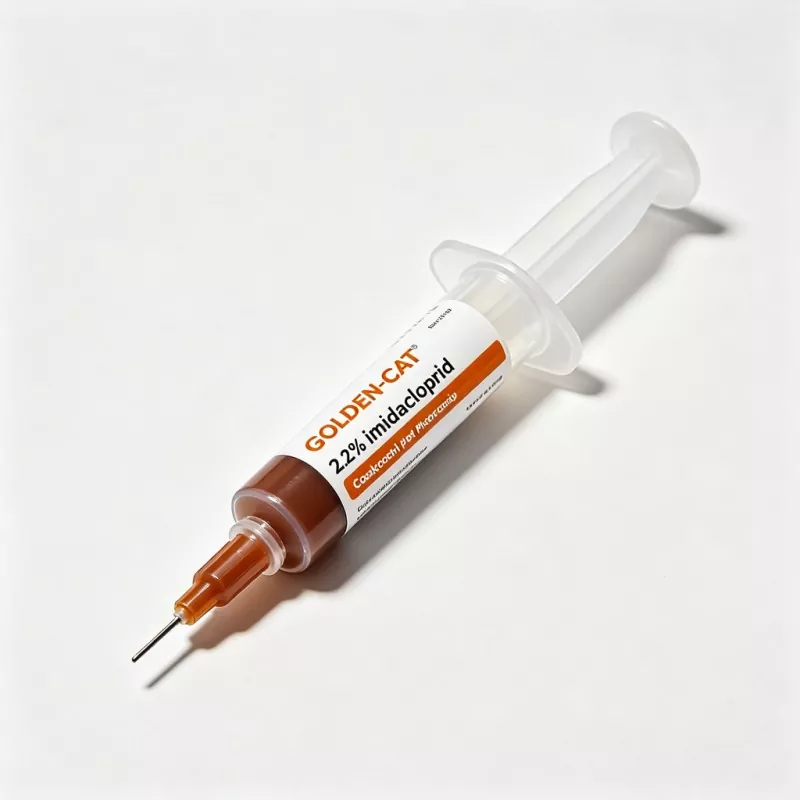
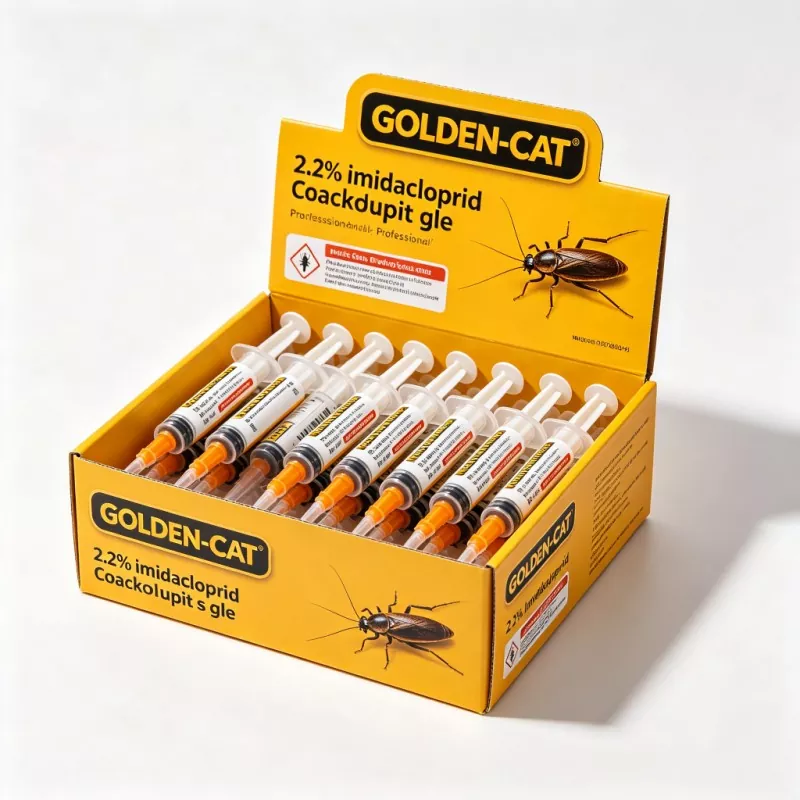
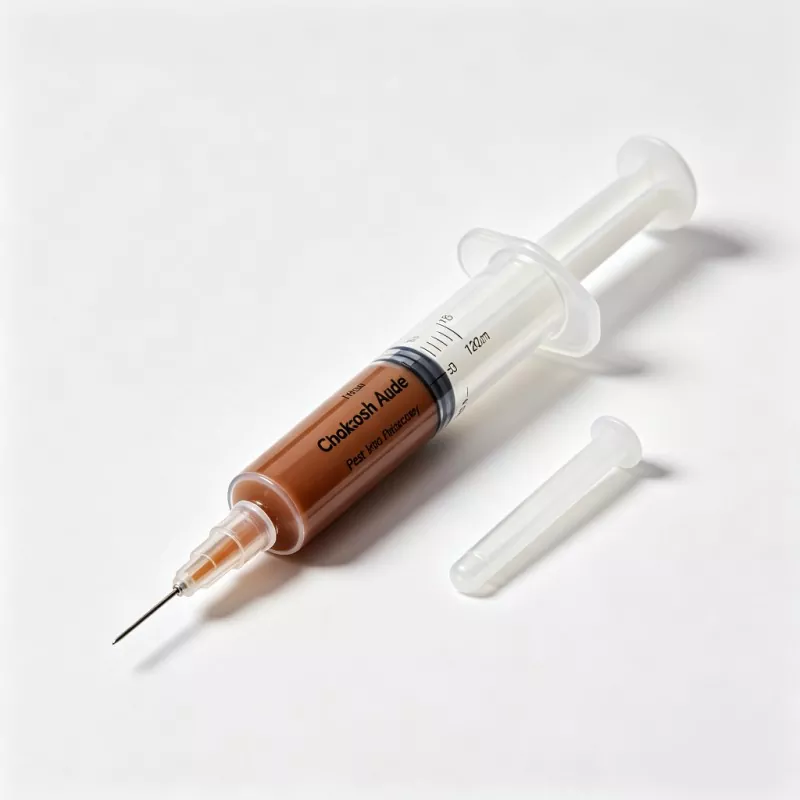
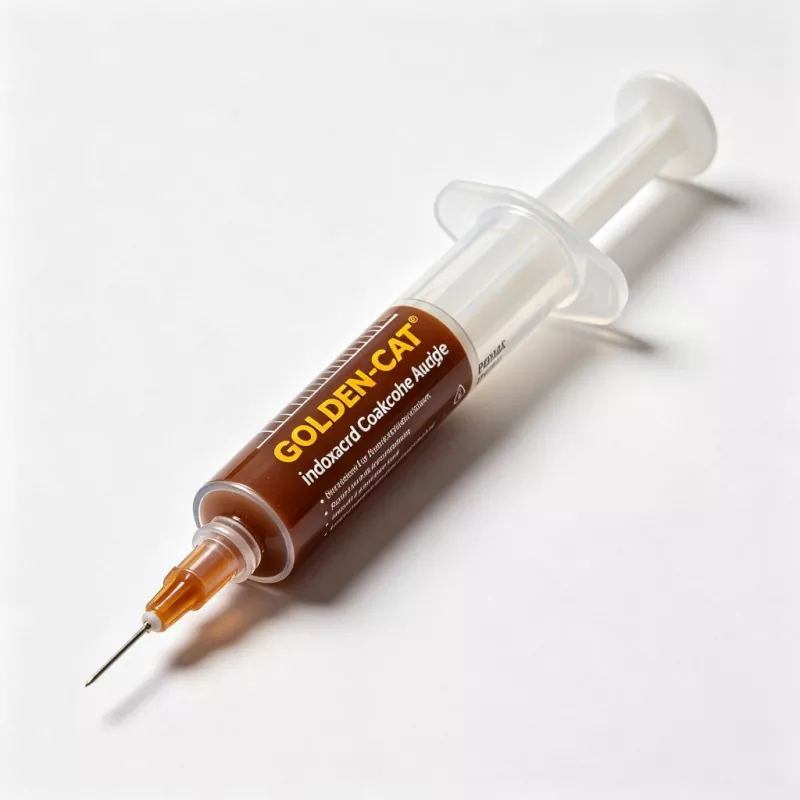
GOLDEN-CAT 2.5% Imidacloprid Cockroach Gel Bait is a professional-grade cockroach control solution featuring 2.5% Imidacloprid active ingredient, formulated for precise, targeted application in commercial, industrial and institutional environments. The syringe-style applicator with precision tip allows for accurate placement of small gel dots in cracks, crevices and hard-to-reach harborages. Imidacloprid, a neonicotinoid-class insecticide, acts on the cockroach nervous system for rapid control, while the highly palatable gel matrix ensures high consumption and effective colony transfer through the domino effect.
Rating: 5.0
(Rating Count: 1)

⚠️ IMPORTANT SAFETY NOTICE: This product contains 2.5% imidacloprid. Read the label before use. Keep out of reach of children and pets. Wash hands after handling. Imidacloprid is toxic to bees. This product is formulated for structural cockroach control and is not intended for outdoor agricultural or foliar use.

GOLDEN-CAT 2.5% Imidacloprid Cockroach Gel Bait Gel is a ready-to-use gel bait supplied in a syringe with a narrow applicator tip. It is intended for placement of small gel deposits into cracks, crevices and confirmed harborages in structural cockroach management programs.

Gel bait performance is determined less by the product alone than by how it is placed. Imidacloprid must be consumed in sufficient quantity to deliver a lethal dose, and the deposit must remain palatable long enough for cockroaches to encounter it during normal foraging. Two variables fall under the applicator’s control: deposit size and location relative to active harborages. Both are governed by label application rates and by inspection findings rather than by product choice alone.

Product Specifications

Brand GOLDEN-CAT
Product Name 2.5% Imidacloprid Cockroach Gel Bait
Active Ingredient Imidacloprid, 2.5% w/w
Chemical Class Neonicotinoid
Formulation Gel bait in syringe applicator
Bait Matrix Food-based gel
Applicator Syringe with narrow-diameter tip
Standard Fill Sizes 5 g / 10 g / 20 g / 30 g / 35 g per syringe. Custom fill available.
Target Species Blattella germanica (German cockroach); Periplaneta americana (American cockroach); Blatta orientalis (Oriental cockroach); Supella longipalpa (brown-banded cockroach)
Application Method Discrete gel deposits into cracks, crevices and confirmed harborages
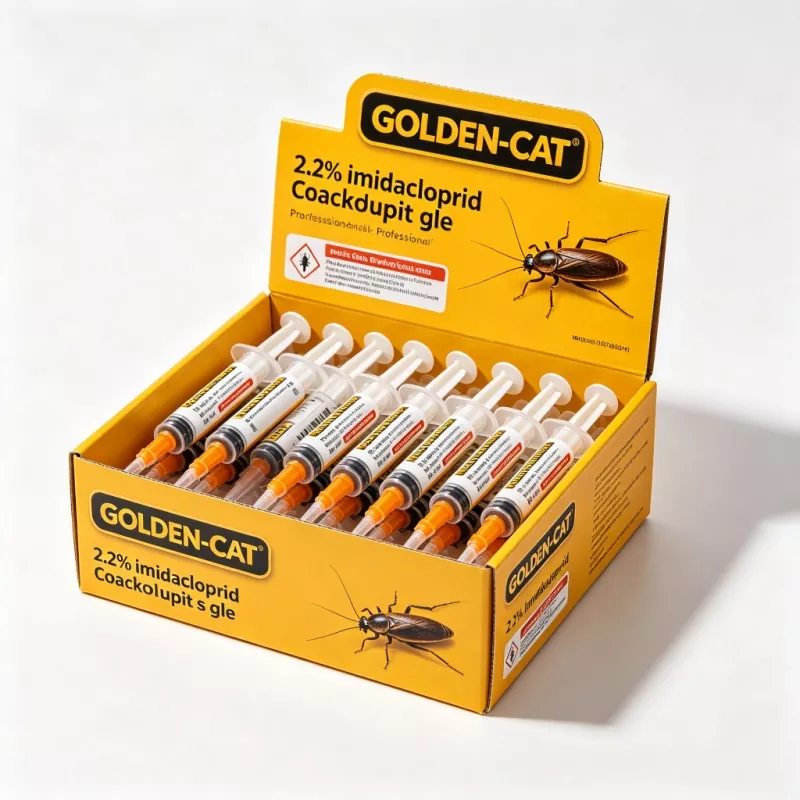
Packaging Individually sealed syringes; display boxes or bulk cartons
Shelf Life 24 months from date of manufacture, sealed, in cool dry storage below 40°C
Available Pack Configurations 1 / 5 / 10 syringes per box; bulk quantities available
Quality Documentation ISO 9001 manufacturing; SDS and COA supplied with each order
Regulatory Status Buyer responsible for confirming local registration and import requirements. Imidacloprid use restrictions vary by jurisdiction.

Deposit Size and Placement Density

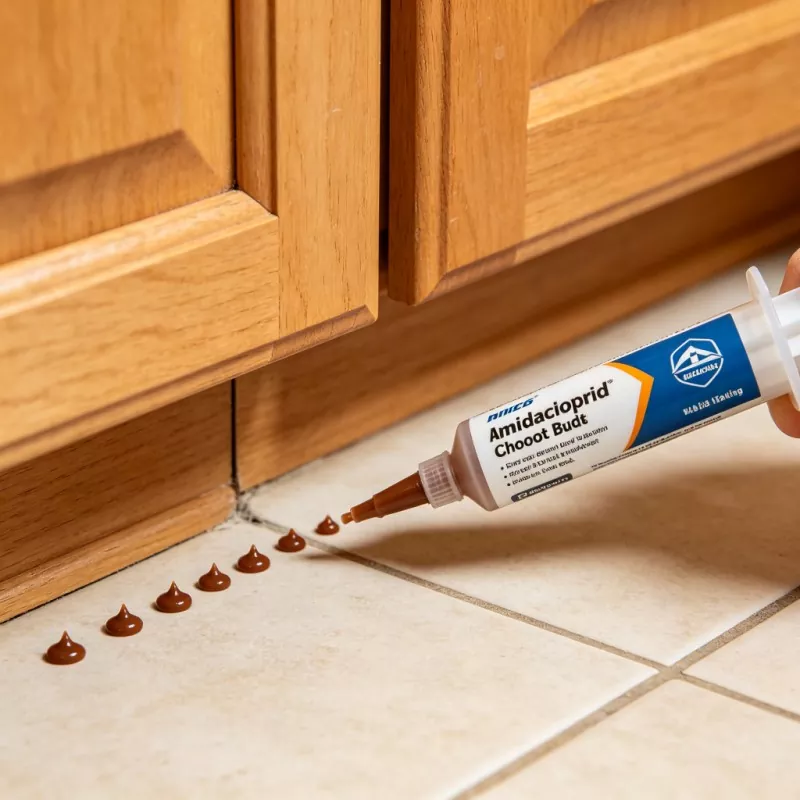
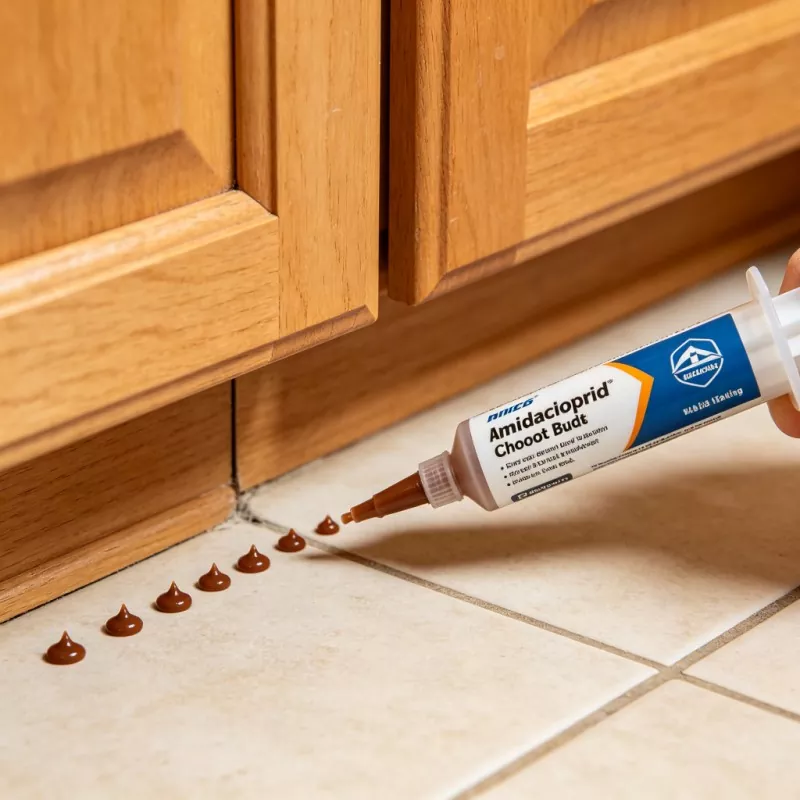
Published EPA-registered gel bait labels and EU authorization documents converge on a consistent principle: numerous smaller deposits provide faster control than fewer larger deposits. The reason is encounter probability. A cockroach foraging along a crack line is more likely to encounter several small deposits distributed along its path than a single large deposit placed at one point.

Parameter Reference point
Deposit weight per point EPA bait quantity reference: a spot of approximately 1/4 inch diameter corresponds to roughly 0.1 g of gel. EU authorization documents for a comparable gel bait reference spots of 4 mm diameter at approximately 0.032 g, and 5 mm spots at approximately 0.05 g.
Maintenance and low infestation EPA label for small cockroach species: 0.75 g per square yard for maintenance programs; up to 1.5 g per square yard for light to moderate infestations. EU reference: 1 to 2 spots of approximately 0.032 g per square meter at low infestation.
Moderate infestation EU reference: 3 to 6 spots of approximately 0.032 g per square meter.
Heavy infestation EPA label: up to 3.0 g per square yard for severe infestations. EU reference: 6 to 10 spots of approximately 0.032 g per square meter.
Large cockroach species EPA label for American, smokybrown and Oriental cockroach: 1 to 2 g per square yard.
Interval between points Place at or near harborages, corners and crack lines. Numerous small placements at close intervals are preferred over wide spacing of larger deposits. Exact spacing depends on harborage density and inspection findings, not on a fixed rule.

These figures are starting references for professional judgment. The applicable label for the batch supplied remains the controlling document for application rate in the destination market.

Surfaces and Co-Application Restrictions

Gel bait adheres poorly to greasy or dusty surfaces, runs on hot surfaces, and loses acceptance if applied adjacent to repellent insecticide residues. EPA label restrictions for gel baits in food handling establishments provide specific thresholds that are useful beyond that setting as general application criteria.

Condition Practical implication
Surface temperature above approximately 54°C (130°F) Gel may run. Examples include portions of stoves, ovens, grills, fume hoods and heat lamps. Avoid these surfaces regardless of setting.
Routinely washed surfaces Bait will be removed by washing before it can act. Do not place deposits on surfaces subject to routine cleaning.
Recently sprayed surfaces Repellent residues reduce bait acceptance. Do not apply gel bait to areas sprayed with a repellent insecticide, and do not spray over existing gel deposits.
Greasy or dusty surfaces Gel may not adhere. Clean or skip the surface; a deposit that falls away cannot be consumed.

Target Species and Placement Implications

The four species covered by this product differ in size and preferred microhabitat. Placement decisions that suit German cockroach do not transfer directly to American or Oriental cockroach.

Species Adult body length, approx. Placement note
Blattella germanica (German) 10 to 16 mm Harbors in tight cracks near warmth and moisture. Deposits should be small and placed inside the crack line, not on adjacent exposed surfaces.
Periplaneta americana (American) 28 to 44 mm Often associated with floor drains, basements and sewer-connected areas. Larger species require higher bait quantity per area, as reflected in the EPA rate table.
Blatta orientalis (Oriental) 20 to 27 mm Prefers cooler, damp locations. Gel may absorb moisture or lose adhesion in persistently damp voids; inspect more frequently.
Supella longipalpa (Brown-banded) 10 to 15 mm Often harbors higher in rooms than German cockroach, including picture rails and furniture undersides. Placement should include elevated locations.

Professional Application

Intended Users

· Licensed Pest Control Operators (PCOs)

· Professional pest management companies

· Certified facility management teams

· Institutional pest control departments

· Food safety and sanitation teams

Application Scenarios

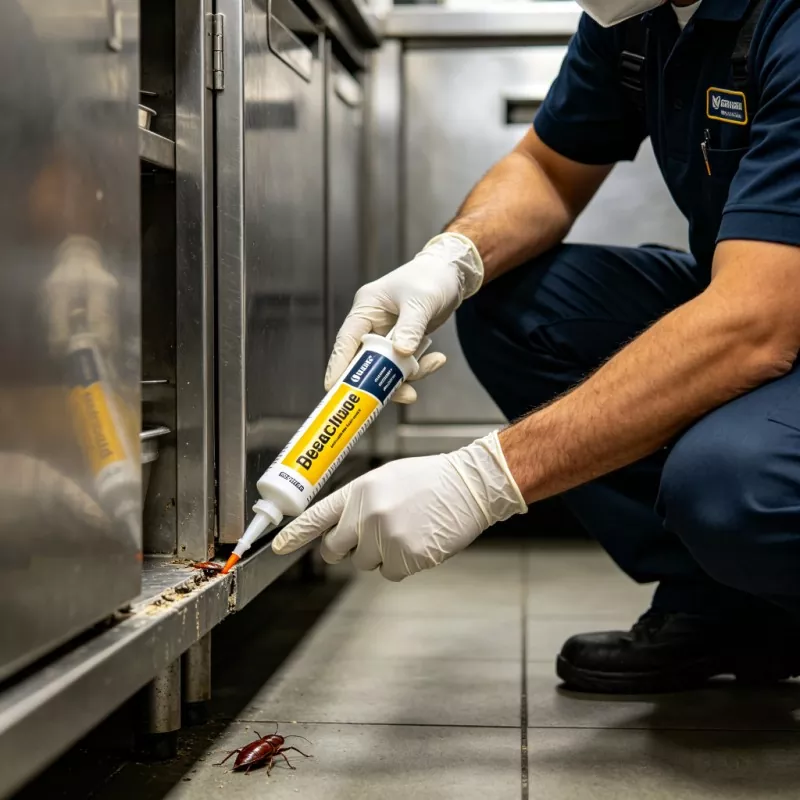
· Commercial kitchens: restaurants, hotels and catering facilities, confined to crack-and-crevice placement

· Food processing: plants, mills and packaging facilities, in accordance with the facility food safety plan

· Institutional buildings: hospitals, schools and government buildings

· Commercial offices: break rooms, kitchens and restrooms

· Retail and grocery: stockrooms, food aisles and receiving areas

· Residential multi-unit: apartment buildings and condominiums

· Industrial facilities: warehouses, factories and break rooms

· Transportation: airplanes, trains, ships and food trucks, subject to the carrier pest management plan

Application Technique

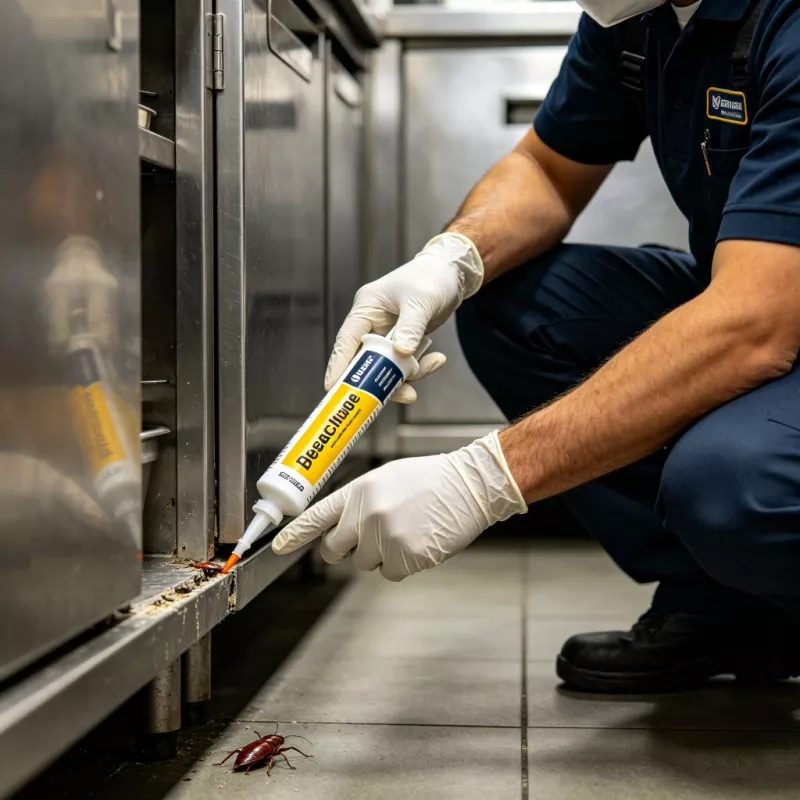
· Confirm active harborages by inspection before placing deposits. Bait placed where activity has not been confirmed adds exposure without contributing to control.

· Place deposits at or near corners, crack lines and aggregation areas. Numerous small placements are preferred over fewer larger ones.

· Insert the applicator tip into the crack or void where possible, rather than placing gel on the adjacent exposed surface.

· For heavy infestations, increase the number of application points and the total bait quantity per area, not the size of individual deposits.

· Do not apply gel over a dust-treated surface. If a dust formulation is used in the same void, allow the dust to settle and document which points are gelled and which are dusted. Gel and dust in direct contact can interfere with each other.

· Re-inspect at 7 to 14 day intervals during active treatment. Replenish consumed deposits. Remove and replace deposits that have dried, hardened or become coated with grease or dust.

Compliance and Handling

· Read the product label before use. The label is the controlling document for use directions, restrictions and PPE requirements in the destination market.

· Wear gloves and eye protection during handling. Avoid contact with skin, eyes and clothing. Wash hands and exposed skin after handling.

· Do not eat, drink or smoke while handling the product.

· Keep out of reach of children and non-target animals. Store in the original container, locked, in a cool dry area separated from food, feed and water sources.

· Dispose of unused product and empty containers according to local regulations. Do not discharge to drains or watercourses.

· Full first aid information is provided in the Safety Data Sheet supplied with each order.

Pollinator-Specific Restriction

Imidacloprid is toxic to bees and other pollinating insects. This product is formulated for structural cockroach control. It is not intended for outdoor agricultural, ornamental or foliar use. In several jurisdictions, neonicotinoid restrictions apply specifically to outdoor ornamental or agricultural applications while structural pest control uses are addressed separately. Applicators and buyers must confirm the registration status of the specific product in the destination market before import or use. The label for the batch supplied governs the permitted use sites.

Bulk Professional Packaging

Supply, Packaging and Shipping Information

Standard fill sizes 5 g, 10 g, 20 g, 30 g, 35 g syringes
Display box 5 or 10 syringes per professional display box
Master carton Varies by pack size
Packaging type Individually sealed syringes; professional display boxes or bulk cartons
MOQ Negotiable for professional clients and distributors
Shipping terms FOB Shanghai, CIF or DDP, subject to regulatory requirements
Payment methods T/T, L/C, Western Union, Trade Assurance
Lead time 15 to 25 days for stock items; 30 to 45 days for custom OEM
Port of loading Shanghai or Ningbo
Documentation SDS, COA, MSDS and export documentation provided
Regulatory compliance Buyer responsible for verifying local import and use regulations, including active ingredient registration status

Frequently Asked Questions

What deposit size and density should be used for German cockroach?

EPA bait quantity references give approximately 0.1 g for a spot of 1/4 inch diameter, and EU authorization documents for comparable gel baits reference 4 mm spots at approximately 0.032 g. At low infestation, 1 to 2 spots per square meter are referenced; at high infestation, 6 to 10 spots per square meter. The EPA label for small cockroach species gives 0.75 g per square yard for maintenance programs, up to 1.5 g per square yard for light to moderate infestations and up to 3.0 g per square yard for severe infestations. The principle behind these figures is that encounter probability increases with the number of small deposits, not with the size of individual deposits. Confirm the exact rate on the label of the batch supplied.

How does imidacloprid bait compare with a spray or residual surface treatment?

Imidacloprid bait relies on ingestion and secondary transfer. It does not deposit a residual film that kills on contact. This means efficacy depends on placement accuracy and continued palatability. A spray may kill cockroaches that contact treated surfaces, but it can also leave repellent residues that reduce bait acceptance if the two are used in the same area without an interval. If a spray has been applied, allow the surface to dry and, where label directions permit, wait before placing gel bait in or adjacent to that area.

What should be done if activity does not decline after a correctly placed application?

The first explanations to investigate are placement and acceptance, not active ingredient failure. Check whether deposits are still present and palatable, whether they were placed inside confirmed harborages, whether the surface was greasy or hot, and whether a repellent spray was applied nearby. If those factors are excluded and the site has a history of repeated imidacloprid bait use, reduced susceptibility becomes a plausible factor. Published field data show that imidacloprid bait performance indices vary widely across populations, and a multi-formulation comparison found the imidacloprid formulation to have the lowest efficacy among the gel baits tested against certain pyrethroid-resistant field populations. Rotation to a bait with a different mode of action is a recognized resistance management practice, but the decision should be based on treatment history and monitoring data, not on a fixed schedule.

Can this gel be used in food handling areas?

Use in food handling areas is governed by the label in the destination market and by applicable food safety regulations. The formulation is intended for crack-and-crevice placement, not for application to food contact surfaces or to areas where food is exposed. EPA label restrictions for gel baits in food handling establishments limit application to crack and crevice treatment and prohibit application to surfaces that are routinely washed, because the bait would be removed before it can act. The buyer or applicator is responsible for confirming that the intended placement is consistent with the local label and the facility food safety plan.

What documentation is supplied with an order, and what does it cover?

Each shipment is accompanied by a Safety Data Sheet and a Certificate of Analysis for the batch. The SDS covers hazard identification, first aid, handling and storage, and disposal. The COA documents active ingredient content and relevant quality parameters for the batch supplied. These documents support the buyer internal hazard communication and quality records. They do not replace the requirement to verify local registration or import eligibility for the active ingredient.

How long does the gel remain effective, and when should deposits be replenished?

Deposits remain attractive and effective for a period that depends on temperature, humidity, surface condition and pest pressure. Inspect at 7 to 14 day intervals during active treatment. Replenish deposits that have been consumed. Remove and replace deposits that have dried, hardened or become coated with grease or dust. Replace bait before it is completely consumed, so that cockroaches continue to encounter it rather than finding only empty points. A visual inspection one month after initial treatment is a commonly referenced checkpoint.

Is imidacloprid restricted in any markets?

Yes, and the restrictions vary by jurisdiction. Some jurisdictions regulate neonicotinoids specifically for outdoor ornamental or agricultural uses while treating structural pest control use separately; others have broader restrictions. The applicable label for the batch supplied is the controlling document for permitted use sites in the destination market. Buyers are responsible for verifying that the intended import and use of the product is permitted under the regulations that apply at the destination.

Do you offer private label or custom fill?

Yes. OEM and ODM are available for professional pest control distributors and brand owners. Custom syringe fill sizes, labeling and packaging formats can be discussed against minimum order quantities. Private label does not alter the buyer responsibility to ensure that the label and claims used in the destination market are compliant with local regulatory requirements.

Send Inquiry
Contact Info
Send your inquiry to Golden Cat for factory price, OEM customization, samples and bulk orders of glue traps, rodenticides and insect bait products.
Rating:
5.0
X
We use cookies to offer you a better browsing experience, analyze site traffic and personalize content. By using this site, you agree to our use of cookies. Privacy Policy
RejectAccept